


 Chat & Connect
 ABOUT BMA
 Bharat Aawaz
Quantum Computing Jumps from Lab to Enterprise: The Race for Fault Tolerance
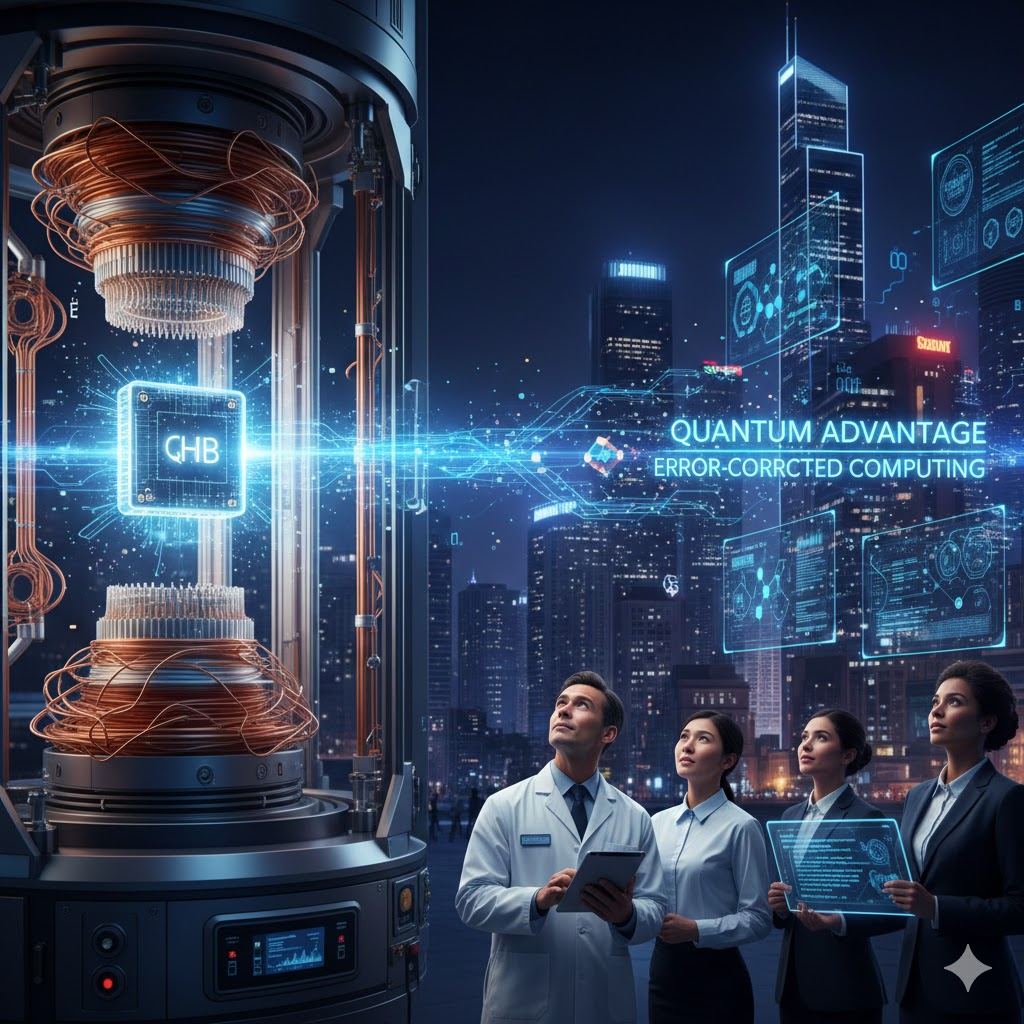
After decades in the realm of high physics, quantum computing has entered a critical phase of commercialization. Major recent milestones in scaling hardware and controlling errors have pushed the technology past its most significant bottlenecks, setting the stage for true "quantum advantage" across key industries
The core of this revolution lies in the ability of quantum bits, or qubits, to exploit quantum mechanics phenomena like superposition (existing as a 0, 1, or both simultaneously) and entanglement (interconnected states) to solve certain problems exponentially faster than any classical supercomputer
Breakthrough 1: Scaling to Commercial Size
The industry is seeing unprecedented growth in processor size, signifying a shift from experimental scale to enterprise scale:
-
10,000-Qubit Processors: Hardware providers, such as QuantWare, have recently announced processors featuring 10,000 physical qubits. This massive scale, 100 times larger than the current industry standard, is essential for tackling the high-complexity problems found in areas like materials science and energy systems
-
Modular Architecture: Companies are overcoming the physical limits of single chips by focusing on distributed quantum computing and networking platforms that interconnect multiple quantum processors. This modular approach is key to achieving the thousands of logical qubits required for utility-scale computing.
Breakthrough 2: Conquering the Error Problem
The most formidable barrier to practical quantum computing has always been decoherence—the extreme fragility of qubits. The quantum state collapses rapidly due to environmental noise, leading to errors
Exponential Error Reduction: A landmark achievement by groups like Google, using their Willow chip, demonstrated exponential error reduction by increasing the number of physical qubits used to encode a single, stable logical qubit.This success of going "below threshold" is the central scientific validation that fault-tolerant quantum computing is achievable
-
The Path to Logical Qubits: This error correction revolution has driven major companies like IBM to set clear roadmaps. IBM is targeting its Quantum Starling system featuring 200 logical qubits by 2029, capable of executing 100 million error-corrected operations. This marks the transition from the noisy (NISQ) era to the fault-tolerant era.
The Dawn of Quantum Advantage
With these foundational hardware challenges yielding ground, the focus now turns to where quantum computing will deliver commercially relevant results: